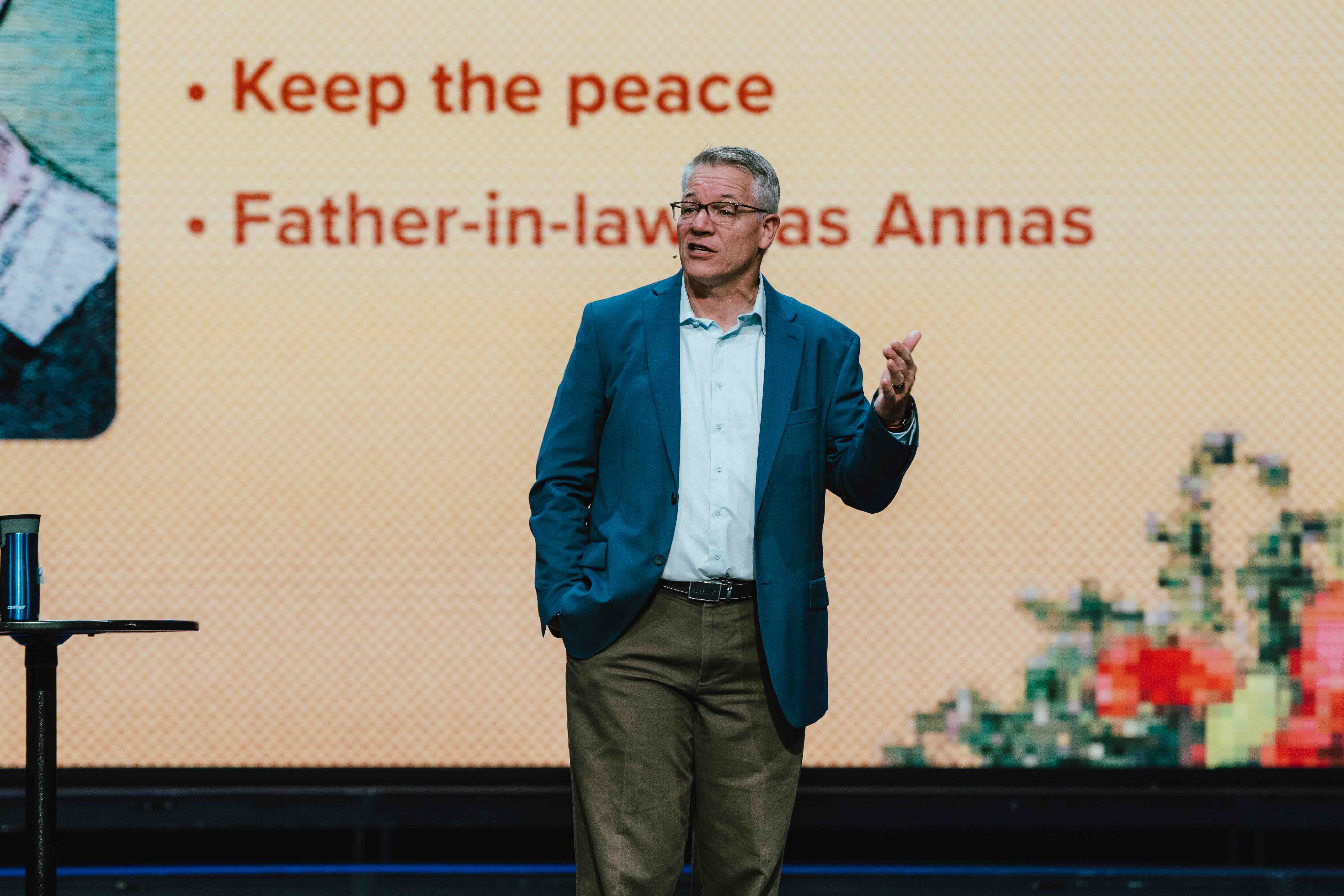
Jesus had just raised Lazarus from the dead. It was an undeniable miracle, and the religious leaders were faced with a decision. Rather than celebrating what Jesus had done, they began plotting how to kill Him.
The Pharisees and Sadducees rarely agreed on anything. They disagreed about resurrection, tradition, and Rome. The priests held power, property, and the temple. The Pharisees held the people's respect. Yet when Jesus called a dead man out of a tomb, they agreed on one thing: He had to go.
Their concern was as much about Rome as it was about Jesus. If Jesus continued gaining followers, they feared a popular uprising that would bring the Roman army down on Jerusalem. Thousands could die, and the temple itself could be destroyed.
They were willing to kill an innocent man, a miracle worker, to keep the peace. They believed they were saving their nation.
But what they didn't understand was that God was doing something far greater.
One Dies for the Many
The religious council was struggling with what to do about Jesus when Caiaphas, the high priest, spoke up.
"You do not realize that it is better for you that one man die for the people than that the whole nation perish." (John 11:50)
There are three things happening in that one sentence.
First, it was a political calculation. Caiaphas believed that sacrificing one man's life was a small price to keep Rome from destroying their nation.
Second, it was an unintentional confession. Caiaphas had no idea what he was really saying. John tells us in verse 51 that he didn't say this on his own, but as high priest that year, he prophesied. God spoke the truth through the mouth of a man who was plotting a murder.
Third, it was a prophecy. John tells us that Jesus would die not only for the Jewish nation, but also for the scattered children of God.
Caiaphas said, "Let him die to save our nation." God said, "Let him die to save the world."
Here is the word for what Jesus did: substitutionary atonement.
Substitutionary means someone takes the place of another. Atonement means making right what was broken. It's the payment for the damage.
Put them together. Jesus walked in and took your place, not at the front of a classroom but on the cross. He took your punishment, and He paid for your mess.
Romans 3 tells us that all have sinned. We're not innocent people who simply needed rescuing from an unfortunate situation. We're guilty. We've sinned against God, and we cannot make ourselves right with Him.
But Jesus can.
Nobody pushed Jesus into this. Jesus willingly laid down His own life for us.
Caiaphas thought somebody had to pay, and it might as well be Jesus. But God had a much greater purpose.
John tells us exactly why in verse 52:
"...to bring them together and make them one." (John 11:52)
One died so the scattered could be gathered.
Why Ephraim Matters
There's a small detail in John 11 that is easy to overlook.
After Jesus raised Lazarus in Bethany, and before He returned for the final events leading to His crucifixion, He withdrew to a town called Ephraim.
John 11:54 tells us:
"Therefore Jesus no longer moved about publicly among the people of Judea. Instead he withdrew to a region near the wilderness, to a village called Ephraim, where he stayed with his disciples."
Ephraim was a remote town in the hill country, roughly 15 miles northeast of Jerusalem. With the religious leaders now looking for an opportunity to arrest Him, it was a practical place for Jesus to withdraw with His disciples.
But perhaps there is something more happening here.
Ephraim was also the name associated with the northern kingdom of Israel. After Solomon died, Israel divided into two kingdoms. Judah was in the south, with Jerusalem and the temple. Ephraim represented the northern tribes, which were eventually conquered by Assyria and scattered.
Throughout the Old Testament, prophets like Hosea, Jeremiah, and Ezekiel spoke about God's promise to gather His scattered people and bring them together again.
In Ezekiel 37, God tells the prophet to take two sticks, one representing Judah and the other representing Ephraim, and join them together so they become one.
Now look again at the sequence in John 11.
In verses 51–52, John tells us that Jesus would die for the Jewish nation and for the scattered children of God, bringing them together and making them one.
Then, just two verses later, Jesus goes to a town called Ephraim.
We can't prove that John intended this as a symbolic connection, but it's worth considering. Jesus has been rejected by the religious leadership in Jerusalem, and He withdraws to a place whose name is associated with the scattered people of Israel.
His coming death would accomplish what the prophets had promised. God would gather His people together.
And the good news would reach far beyond the borders of Israel.
God Cares About Those Who Are Scattered
So, more than a fascinating teaching point, what does this mean for you and me?
It means that God is always concerned about people who are not here. People who are not insiders. People who are lost and scattered.
Judah AND Ephraim. South AND North.
God cares about those who are gathered and those who are scattered.
That should cause us to ask some important questions.
Who is not here that should be? Where is there an outsider who I can make an insider? Who is unchurched, dechurched, independent, skeptical, or unloved who needs the good news of Jesus and the church?
This is why we each identify one person who is outside of the fold that we will pray for every day. Build a relationship with them. Love them. Invite them. Share Christ with them. Whatever it takes.
Because Ephraim matters. People on the outside matter. They are worth our attention.
In fact, all of us used to be Ephraim until someone reached out to us!
And never underestimate your role in reaching those people.
There can sometimes be a strange assumption that ministers or church staff are the most important people in a church. No way.
Church staff are the support network for the people who are really getting the job done. Ministers are the equippers, and the congregation is the "get it done" crew. Ministers are the coaches, and congregations are the players on the field.
You have access to people, proximity, classmates, coworkers, and teammates. You have relationships with people who may never walk through the doors of a church unless someone like you reaches out.
Never underestimate the importance of your role, because Ephraim matters to God.
And this mission doesn't stop with the people who live next door.
Ephraim also reminds us of those who have been scattered everywhere. For more than 100 years, Christ Community Church has been committed to taking the best news ever to the least reached people.
When we send missionaries, plant churches in least reached places, and choose to pray, know, give, and go, we're participating in God's work of reaching those who are scattered.
The generosity and faithfulness of God's people allow the good news of Jesus to reach people around the world.
Let's keep doing that.
Who Is Your One More?
Caiaphas said one man should die so the nation wouldn't be scattered.
Jesus died so the scattered could be gathered.
In Ezekiel, God spoke about taking two sticks and joining them together as one. And through Jesus, God reconciled His people to Himself through two pieces of wood in a different shape.
The cross.
We were all reconciled through the cross. We were all once outsiders, separated from God by our sin, until Jesus made a way for us to come home.
You were Ephraim once.
And chances are, someone told you the story of Jesus. Someone prayed for you, invited you, loved you, or helped you understand the good news.
So who's your "one more"?
Think of their name. Picture their face. Decide on one way you will love them, reach them, or tell them about Jesus.
Because God still cares about those who are scattered.
One died so the scattered could be gathered.
Message recap adapted from the November 15, 2026, message by Minister Mark Ashton.



Download Our App
Grow in your faith and build daily habits using our app.