God designed us intentionally and purposefully from the beginning. But sin corrupted us and the way we reflect His intentions and designs.
Think about what happens when an EF4 or EF5 tornado hits a house. Winds of 166 to more than 200 miles per hour can level it. Someone coming upon the wreckage later might recognize some of the materials or identify where the foundation once stood, but from the wreckage alone, it would be difficult to know what the completed house originally looked like.
To know that, you would have to go back to the blueprint.
Sin hit God’s creation like a tornado. It left the state of women discernible, but desperately altered from God’s original design. So if we want to understand what it means to be a woman, we have to go back to the Creator, the Designer Himself.
And we are blessed because God not only speaks about His design in Genesis, but shows us through Jesus Christ what His intentions for women look like.
Women Were Created in the Image of God
Genesis begins with something foundational:
“So God created mankind in his own image, in the image of God he created them; male and female he created them.”
Women are not an afterthought or a Plan B. Women, like men, are God’s image-bearers.
That speaks first to who we are.
God made us able to relate to Him, to think, to feel, and to act with moral responsibility. But before we ever did anything good or bad, God determined that humanity would bear His likeness.
That means our value does not begin with what we accomplish.
Women belong first to God, not to any man. And as His likeness, our lives have God-given value.
Too often, we begin believing our value comes from what we do or how we show up. Sometimes we learn this from a broken culture. Sometimes we even learn it from a church that is not deeply rooted in biblical truth.
But Scripture gives us something much more secure.
Woman, you were made in the image of God.
Whether you work or don’t work, are married or single, have children or don’t have children, do ministry or don’t, your value does not come from any of those things. You have value because God made you like Him.
This truth became deeply personal for Chaka after the death of her 11-year-old son, Landen. For much of her Christian life, she had been a stay-at-home mom while also serving in different ministry roles. Suddenly, she no longer had her son to mother, and in the weight of grief, ministry stopped as well.
She struggled with her value.
But during that season, when she felt unable to move, let alone do anything for God, He reminded her of something deeper than her usefulness.
She was inherently valuable to Him.
Chaka. His image-bearer.
Loved and wanted because He made her in His likeness.
That truth is not dependent on the season you are currently in.
Whether you are walking closely with God, drifting from Him, or still seeking, allow this truth to speak louder than what anyone else might say and even louder than how you feel:
Woman, you were made in the image of God, and because of this, you have inherent dignity and value.
You’re not just allowed in the room.
You have an invitation and a seat at the table.
But bearing God’s image is not only about who we are. It also has an active component: what we are called to do.
Genesis 1 says God blessed the man and woman together and gave them the commission to be fruitful, fill the earth, subdue it, and rule over creation.
Women are not spectators in God’s purposes for the world.
We are commissioned participants.
Dominion does not mean lording power over others. It means exercising wise, God-reflecting stewardship over what He has made: cultivating it, protecting it, ordering it, and helping it flourish.
Women build homes and communities. We cultivate, create music, solve problems, establish institutions, educate children, heal bodies, write books, design technology, administer justice, create culture, disciple others, care for vulnerable people, and develop ideas that can bless generations after us.
Whether our sphere of influence is the home, workplace, church, arts, education, medicine, business, government, or neighborhood, we can take what God has placed before us and help it flourish.
Genesis 2 adds another dimension to that purpose.
God says:
“It is not good for the man to be alone. I will make a helper suitable for him.”
The Hebrew expression is ezer kenegdo.
Ezer means help or helper, but it does not describe an inferior assistant. The word frequently describes powerful help, including the help God Himself gives His people.
An ezer is one who provides needed aid.
Kenegdo describes one who corresponds to another.
The woman is therefore neither a duplicate of the man nor a lesser version of him. She is his corresponding human partner: like him enough to share his humanity and vocation, but different enough to stand across from him and bring something genuinely complementary to the partnership.
Women and men were not created for competition.
We were created for each other.
Together, man and woman are equipped to carry out the commission God gave humanity.
Sin Distorted the Blueprint
That is the picture.
That is the blueprint.
But then the tornado of sin tore through humanity.
Adam and Eve lived together in the garden, working in harmony and experiencing the presence of God Himself. But they listened to the serpent’s lies, mistrusted God’s motives, and disobeyed Him.
Shame entered the story.
They hid.
And the consequences of sin touched everything.
The harmonious partnership between man and woman fractured. Instead of working together to express God’s image to creation, a power struggle entered their relationship.
Genesis 3 says to the woman:
“Your desire will be for your husband, and he will rule over you.”
It is important to understand what this means.
Sometimes Christians read the consequences announced in Genesis 3 almost as though they are commands for how life should operate.
But think about the rest of the passage.
God says childbirth will become painful, but we don’t conclude women should suffer as much as possible during childbirth. We develop medicine to ease the pain.
God says Adam will experience thorns and painful toil, but we don’t tell farmers to put down their tractors because God said farming is supposed to hurt. We develop irrigation systems, machinery, and combines.
Why?
Because we recognize these things as consequences of the Fall, not commands from God.
So why would we automatically understand “he will rule over you” differently?
The dominance of men and the desire of women to climb to the top are both part of the Fall, not the original plan of God.
This is not God’s best. It is our corruption.
Before sin, woman is Adam’s ezer kenegdo: his corresponding helper, his human counterpart.
After sin, their relationship is fractured.
And women tumble through history often marginalized, exploited, abused, treated as lesser partners, denied a public voice, and excluded from opportunities and positions of influence.
Woman striving against man and man striving against woman leaves chaos, brokenness, and deep wounds in people who were created to cultivate order, harmony, and flourishing.
But God.
Those might be two of the most hope-filled words in Scripture.
But God.
God didn’t disown Eve in the garden.
She remained His image-bearer.
And God already had a redemption plan.
Jesus Restores the Original Blueprint
In Genesis 3:15, God promises that one day a descendant of Eve would crush the head of the serpent.
That promise points forward to Jesus Christ.
Jesus would become the curse for us in order to destroy the power of the curse over us.
The tornado of sin came.
But Jesus is the curse-breaking, serpent-crushing, relationship-restoring Son of God.
And when we look at how Jesus interacts with women, we begin seeing God’s original design coming back into focus.
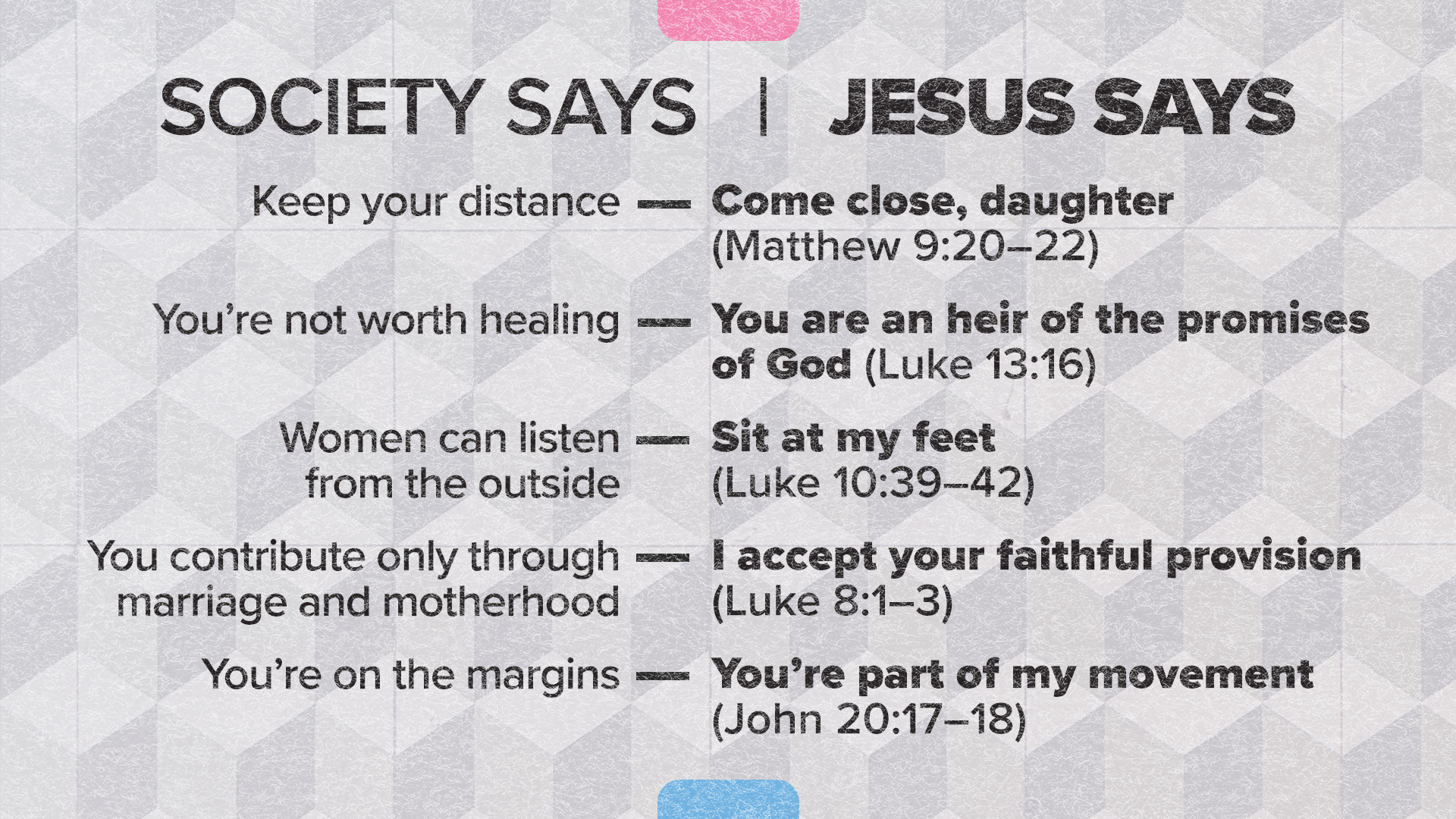
Society says, Keep your distance.
Jesus says, Come close, daughter.
Society says, You’re not worth healing.
Jesus calls a suffering woman a daughter of Abraham, an heir of the promises of God.
Society says, Women can listen from the outside.
Jesus allows Mary to sit at His feet as a disciple and listen to His teaching.
Society says, Your contribution is only through marriage and motherhood.
Jesus receives the faithful financial provision of women who supported His ministry.
Society says, You’re on the margins.
Jesus makes women part of His movement.
And after His resurrection, Jesus sends Mary Magdalene to His disciples with the message:
“I have seen the Lord!”
God’s story for Eve did not end with her sin.
And God’s story for us does not end with the ways sin has distorted His original design.
Woman, the question isn’t what society says you should be, what church culture says you should be, or even what you feel you should be.
The question is:
Who does God’s blueprint say you were designed to be?
You were designed to be God’s image-bearer. Not anyone else’s.
You were designed to exist in harmonious, productive relationship with God and with others.
You were co-commissioned with man to create order, beauty, and abundance for the glory of God.
You were created to bring your strength, wisdom, intelligence, creativity, perspective, gifts, and influence into whatever God has entrusted to you.
Our gifts, bodies, relationships, work, creativity, strength, and influence ultimately point beyond ourselves to our Creator.
So perhaps the question to carry with us is this:
How can I personally cultivate what has been entrusted to me—what is within my sphere of influence—to bring order, cultivate life, and cause what is within that sphere to flourish, all for the glory of God?
Message recap adapted from the August 23, 2026, message by Chaka Heinze.


Download Our App
Grow in your faith and build daily habits using our app.