

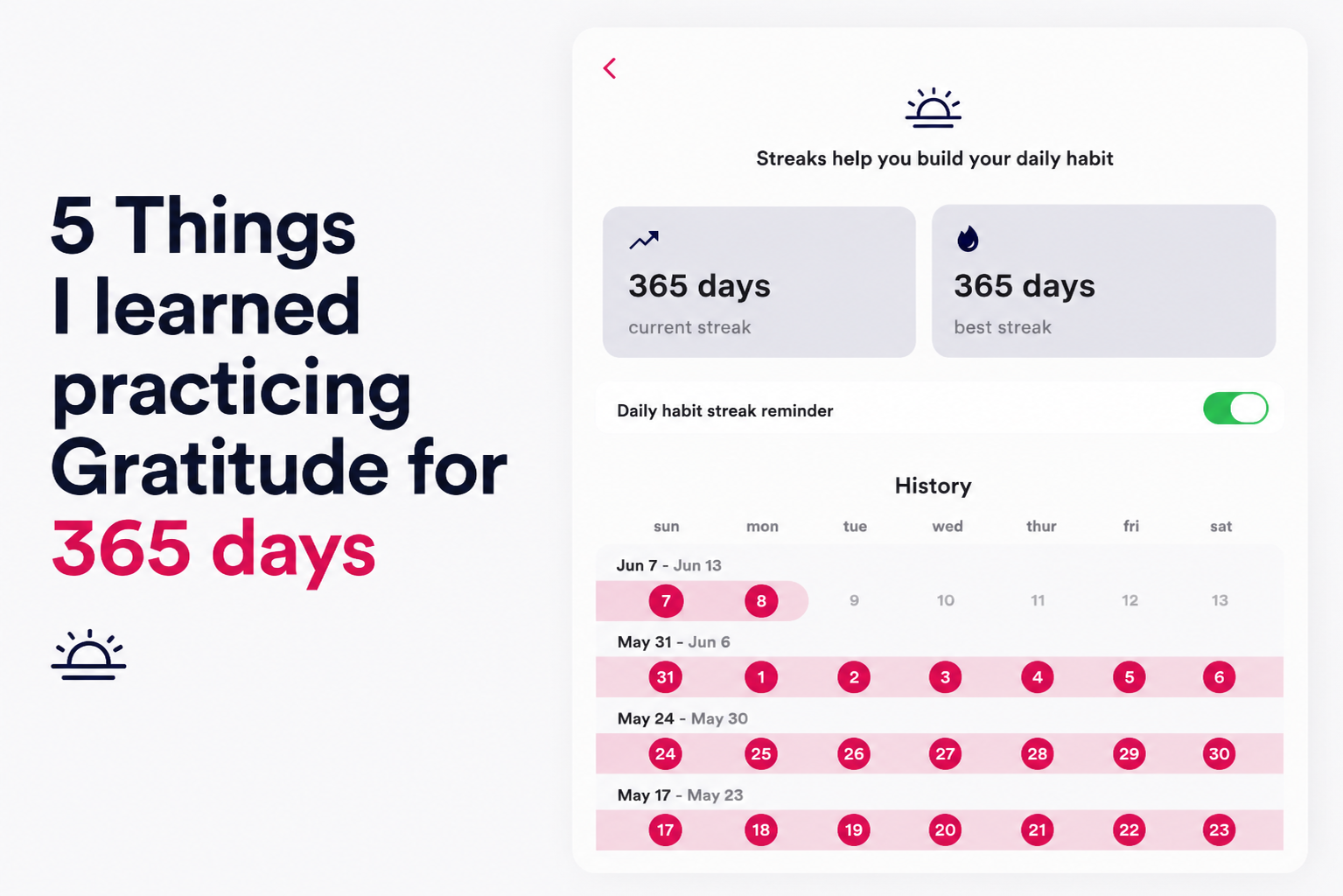
The most surprising thing I learned after practicing gratitude for 365 days wasn't how much I had to be thankful for. It was how quickly I forget.
I forget answered prayers. I forget blessings. I forget how much of life is gift.
The job I once prayed for becomes the job I complain about. The relationships I once celebrated become relationships I assume. The blessings I once thanked God for slowly become expectations.
The human heart has a remarkably short memory.
A year ago, I decided to push back against that tendency.
To be completely honest, this wasn't entirely my idea. As part of a larger project I was helping lead at Christ Community Church, we were exploring ways to help people build meaningful daily habits that would help them grow in their faith. Gratitude was one of those practices.
There is more to that story. There is also more to the larger project itself. I'll share that another time.
Somewhere along the way, however, I realized I couldn't encourage others to embrace a practice I wasn't willing to try myself.
So I made a commitment.
For the next 365 days, I would keep a simple gratitude journal.
Now if you know me well, you'll know this kind of challenge isn't exactly my strength.
I tend to start strong. Really strong.
Then life gets busy. I miss a day. Then I miss another. Before long, I've convinced myself that because I can't do it perfectly, it isn't worth doing at all.
Maybe you've been there too.
But this time I wanted to push through. I wanted to see what would happen if I stayed faithful to one small practice for an entire year.
Each day I responded to a few simple prompts that helped me reflect on where I had seen God's goodness, provision, and grace. Some days the entries came easily. Other days, admittedly, they took more effort.
But after 365 days, I learned a few things I wasn't expecting.
1. Gratitude Doesn't Change Your Circumstances. It Changes Your Attention.
One of the first things I noticed was that gratitude didn't magically make life easier.
There were still stressful days. Still disappointments. Still frustrations. Still moments when things didn't go according to plan.
What changed was what I paid attention to.
When you intentionally look for reasons to be grateful, you begin noticing things that would have otherwise slipped past you. A conversation with one of my kids... A text from a friend at exactly the right moment... A meaningful interaction after church.... A laugh around the dinner table... An unexpected opportunity... A prayer answered...
The blessings were already there.
Gratitude simply trained my eyes to see them.
It's amazing how much of life can be missed when we're only paying attention to what's wrong.
I didn't suddenly receive more blessings during this year. I simply became more aware of the blessings that had been there all along. Praise Jesus!
2. The Human Heart Adapts Faster Than We Realize.
Psychologists call it hedonic adaptation. It is our tendency to quickly adjust to positive circumstances until they become normal. In other words, we get used to blessings much faster than we realize.
The job we prayed for becomes the job we complain about... The healthy marriage we once thanked God for becomes something we assume will always be there... The home we dreamed of owning becomes the home that isn't quite big enough...
What once felt like a gift begins to feel expected.
What struck me during this year is how often we assume that if we just had a little more, we'd finally be satisfied. More money. More comfort. More success. More possessions.
Yet I recently came across research cited by Drew Hyun in his book Beautiful, Disappointing, Hopeful that challenged that assumption. Studies have shown that mental health struggles are often most prevalent in developed countries, suggesting that prosperity and wealth alone are not the solution to our emotional and mental condition.
That observation has typtically become the most clear after I've seen glimpses of it firsthand during mission trips.
Some of the people I've met who possessed the least materially often displayed extraordinary joy, generosity, and gratitude. At the same time, some of the wealthiest communities in the world continue to wrestle with loneliness, anxiety, depression, and dissatisfaction.
Of course, poverty brings its own hardships and challenges. No one should romanticize that reality.
But perhaps the research reminds us of something important.
The human soul was never designed to be satisfied by possessions alone.
The problem isn't that we have too much.
The problem is that we forget.
What we stop receiving as a gift, we eventually begin treating as a guarantee. And when blessings become expectations, gratitude often gives way to resentment.
3. Gratitude Can Literally Rewire Your Brain
One of the unexpected gifts of this journey was getting the opportunity to interview Dr. Lee Warren on the unCOMFORTABLE podcast.
Dr. Warren is a neurosurgeon who has spent years studying the connection between our thoughts, our brains, and our overall well being. During our conversation, he talked about something that fascinated me. The brain is constantly adapting. It is never static. The thoughts we repeat, the stories we tell ourselves, and the things we consistently focus on all contribute to how we experience the world around us.
Over time, our brains strengthen the pathways we use most often.
Gratitude isn't just a spiritual practice. It can actually begin to rewire your brain.
The more we intentionally notice God's goodness, the more natural it becomes to recognize it. The more we pay attention to grace, the easier it becomes to see grace. What begins as a discipline can eventually become a lens through which we view the world.
That doesn't mean gratitude eliminates hardship. It doesn't erase grief, remove pain, or solve every problem. There were plenty of difficult days during this year. Gratitude did not make those days disappear. What it did do was keep those difficult moments from becoming the only thing I could see.
It didn't change every circumstance. It changed what received my attention.
What struck me most was realizing that modern neuroscience continues to affirm something Scripture has been teaching all along.
This is why we must take aim at our thoughts, because our thoughts aim us.
I think this is what Paul was getting at when he encouraged believers to think about whatever is true, honorable, just, pure, lovely, and commendable in Philippians 4:8. Our attention shapes us. Gratitude helps direct our attention toward grace.
4. Gratitude and Grief Can Occupy the Same Space
One misconception I had about gratitude was that it belonged primarily to good seasons. I assumed gratitude was easiest when life was working, prayers were being answered, and circumstances were moving in the direction I wanted them to go.
But some of my most meaningful journal entries came on difficult days.
Days marked by loss. Days filled with uncertainty. Days when prayers seemed unanswered. Days when I felt tired, discouraged, or overwhelmed by things happening around me.
Gratitude did not remove those realities. It simply reminded me they weren't the only realities.
Pain may be part of the story. It is not the whole story.
The Bible never asks us to deny pain. Jesus Himself wept. The Psalms are full of lament, questions, and cries for help. The Christian life has always made room for grief. Gratitude is not pretending everything is okay. Gratitude is recognizing that God's presence and faithfulness can still be found even when life feels heavy.
What gratitude taught me is that sorrow and thanksgiving are not enemies. They can occupy the same space. In fact, some of the deepest gratitude I experienced came in moments when I needed God's grace the most.
Gratitude isn't the absence of grief. It's remembering grace in the middle of it.
In many ways, gratitude became less about feeling good and more about remembering what was true.
Even on the hard days.
Especially on the hard days.
5. Gratitude Is a Habit Before It Becomes a Perspective
I used to think gratitude was primarily an emotion. Something you felt when life was going well. Something that appeared naturally when circumstances lined up in your favor.
After a year of practicing gratitude, I think differently.
Gratitude is a discipline long before it becomes a perspective.
Most of my gratitude entries weren't profound. There were no lightning bolt moments. No life changing revelations. No dramatic spiritual experiences. Most days consisted of a few simple reflections on ordinary moments that could have easily gone unnoticed.
Most days were ordinary.
And that's precisely the point.
Over time, small actions shape us. Tiny habits repeated consistently often have a greater impact than dramatic moments. We tend to overestimate what can happen in a day and underestimate what can happen in a year.
Day after day, gratitude slowly moved from something I did to becoming part of how I viewed life. I didn't notice the change happening in real time. But looking back, I can see it.
Not perfectly.
Not completely.
But noticeably.
The practice eventually became a perspective.
And I suspect that's how most spiritual formation works. Rarely through a single breakthrough. More often through ordinary faithfulness repeated over time. One prayer. One act of obedience. One moment of gratitude at a time.
Usually through ordinary faithfulness repeated over time.
After 365 days, I'm convinced of something.
When I started doing these daily journals, I thought gratitude would help me become more thankful. It certainly did that. But what surprised me most was how much it exposed my tendency to forget.
Forget answered prayers.
Forget God's provision.
Forget how many things in my life began as gifts that slowly became expectations.
Over the course of a year, gratitude became less about writing something down in a journal and more about learning to pay attention. It reminded me that God's goodness is often present in ordinary moments that are easy to overlook when life gets busy.
Gratitude doesn't change everything. But it changes the way you see everything.
It reminds you that life is filled with gifts you've stopped noticing. It slows the drift from gratitude to entitlement. It helps you remember what God has already done instead of becoming consumed by what you wish He would do next.
Perhaps that is why gratitude has been such a central theme throughout the Christian story. Again and again, God calls His people to remember. Remember His faithfulness. Remember His provision. Remember His promises. Gratitude is one of the ways we practice that remembering.
The problem isn't always that God has stopped providing.
Sometimes we've simply stopped noticing.
I should also admit that I probably would not have completed this challenge on my own.
One of the reasons I stayed consistent was because the practice was built into the Christ Community Church Omaha app. The daily prompts, reminders, and accountability helped transform a good intention into a sustainable habit. What started as part of a larger project eventually became a meaningful personal practice.
Without that structure, I'm not sure I would have made it all 365 days.
In fact, that may be one of the biggest lessons of all.
Growth rarely happens by accident. Most of us need rhythms, reminders, and community to help us become the people we want to be. Left to myself, I probably would have missed a few days, gotten discouraged, and quietly moved on to something else.
Instead, I stayed with it.
And I'm grateful I did.
Sometimes growth isn't about trying harder.
Sometimes it's about creating the right environment for faithfulness to flourish.
One year later, I'm grateful for the practice.
More importantly, I'm grateful for what the practice helped me remember.
The human heart has a short memory.
Gratitude helps us remember.
- Alex


Download Our App
Grow in your faith and build daily habits using our app.